Every toddler toy aisle eventually splits into two camps: quiet wooden toys that do nothing until the child acts on them, and electronic toys that light up, talk, and respond on their own. Parents often end up buying both and then wondering which one actually “counts” as the better educational investment. The honest answer is that they teach different things, and the choice matters less than people assume — but it’s still worth understanding what each is actually good at.
What Open-Ended Wooden Toys Do Well
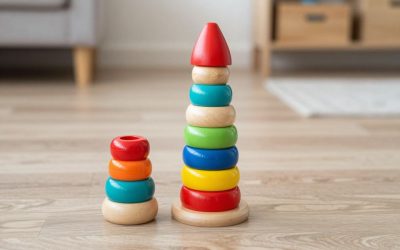
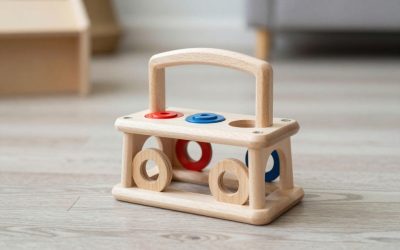
Wooden blocks, shape sorters, and stacking toys don’t have a single correct outcome dictated by the toy itself — the child supplies the goal. That open-endedness is linked to stronger problem-solving and creative play in early-childhood research, mainly because the child has to generate ideas rather than respond to prompts the toy provides.
Melissa & Doug 100-Piece Wooden Building Blocks Set
A large, varied block set that stays useful across a wide age range precisely because there’s no fixed ‘win’ condition — a toddler builds whatever occurs to them that day.
Melissa & Doug Stack & Sort Board
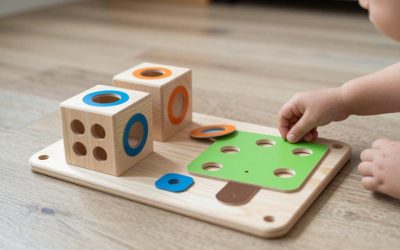
A self-correcting sorter that still requires the child to do the matching work themselves, rather than a toy that announces the right answer.
PlanToys Wooden Rainbow Stacker
A sustainably produced wooden arch set that can be stacked as a rainbow, lined up as a tunnel, or used as freestanding shapes, giving a toddler no fixed “correct” configuration and plenty of room to invent new uses as they get older.
What Electronic Learning Toys Do Well
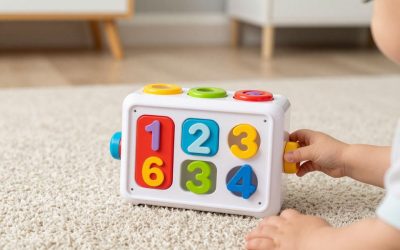
Electronic toys are strong at consistent, high-volume repetition — the exact sound of a letter, the same phrase modeling correct grammar, a song reinforcing a counting sequence. A tired parent isn’t always going to repeat “B says buh” twenty times in a row with perfect consistency; a toy will.
VTech ABC Learning Apple
Reliably repeats letter names and phonics sounds every single time a button is pressed, which is difficult for even a patient parent to match in consistency over dozens of repetitions.
LeapFrog Match and Learn Cookies
Pairs letter sounds with matching and color recognition in a single toy, covering several skills in the same repeated-play loop.
Fisher-Price Laugh & Learn Smart Stages Puppy
An electronic plush puppy that teaches counting, colors, and letters through a mix of songs and phrases, with a “Smart Stages” setting that changes the content and complexity as the toddler ages, so the same toy stays relevant longer than a fixed-content electronic toy.
The Screen-Time Question (These Aren’t Screens, But…)
Electronic toys with lights and sound aren’t screens and don’t carry the same guidance against toddler screen exposure, but some early-childhood specialists note they can still crowd out the slower, self-directed play that wooden and open-ended toys encourage, simply because button-pressing is easier and more immediately rewarding than figuring out what to build. This isn’t a reason to avoid electronic toys — it’s a reason to keep both types available rather than letting one dominate the toy bin.
A Practical Split, Not a Choice
Most early-childhood guidance lands on using both, in different contexts: electronic toys for solo, short bursts of play (waiting rooms, car rides, a few minutes of independent play while a parent cooks), and open-ended wooden toys for longer stretches of supervised or parallel play where there’s time for exploration and building. Neither replaces actual back-and-forth interaction with a caregiver, which remains the strongest driver of early language development regardless of which toy is in hand.
How to Decide What to Buy First
If a toddler already has several electronic toys and seems to default to button-pressing over building or sorting, adding a wooden open-ended toy (blocks, a stacking/sorting board) tends to round things out. If a toddler has mostly wooden toys and shows little interest in letters or numbers yet, one electronic toy focused specifically on that gap (an alphabet toy, a counting toy) can help without needing to overhaul the whole toy collection.
Noise and battery life are worth factoring into the decision beyond the educational framing, since these are the details that actually determine how much a toy gets used day to day in a real household. Electronic toys with a fixed loud volume and no auto-shutoff tend to get retired to a closet faster than ones with adjustable volume, simply because constant repeated phrases and songs wear on adults in the room far faster than they wear on the toddler using them. Open-ended wooden toys have no such limitation since they’re silent by design, which is part of why they tend to stay in active rotation for a longer stretch of a toddler’s development without needing to be “rested.”
FAQ
Are electronic learning toys actually bad for toddler development?
No — the concern isn’t that they’re harmful, it’s that an all-electronic toy collection can crowd out open-ended play if nothing else is available. Used alongside other toy types, they’re a reasonable part of a toddler’s toy rotation.
Do wooden toys really matter more than the specific brand?
Generally yes — the self-correcting, open-ended design matters more than whether a toy happens to be made of wood versus well-made plastic. Wood is simply the common material for toys built around that design philosophy.
My toddler only wants the electronic toys and ignores the wooden ones. What should I do?
Try rotating toys out of constant availability rather than removing the electronic ones outright — many toddlers return to quieter, open-ended toys once the electronic options aren’t always the easiest thing in reach.
Is there an age where one type becomes clearly more appropriate than the other?
Not sharply — both types have versions appropriate from roughly 12 months onward. What usually shifts with age is complexity (simpler cause-and-effect toys earlier, multi-step building or letter-sound toys later), not a hard switch from one category to the other.
Write Your Review
No reviews yet. Be the first to share your experience!