Stacking and sorting toys look simple, but they’re doing real developmental work: hand-eye coordination, size and color discrimination, and the planning involved in figuring out which piece goes where before trying it. The right pick depends mostly on your toddler’s current stage — a 12-month-old needs something far more forgiving than a 2.5-year-old.
The Classic Starting Point (6-18 Months)
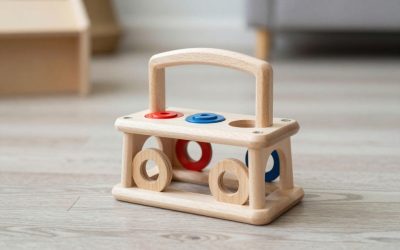
For the earliest stacking attempts, a toy that’s hard to get “wrong” matters more than complexity.
Fisher-Price Rock-A-Stack
The long-running classic ring stacker with a wobble base — the forgiving, slightly tippy base makes it easier for early stackers to grasp and place rings without needing precise aim.
Sort-by-Multiple-Attributes (18 Months+)
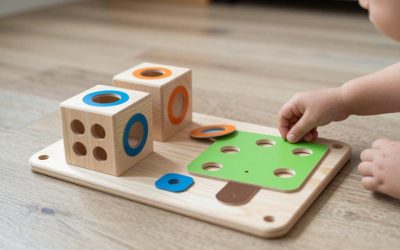
Once simple stacking feels too easy, boards that require sorting by shape, color, and number at once add real challenge.
Melissa & Doug Stack & Sort Board
A solid wood board with five pegs letting toddlers sort 15 pieces by shape, color, and number — the self-correcting design means a piece simply won’t go on the wrong peg, so toddlers can check their own work.
Wood City Wooden Sorting and Stacking Toy
Functions as a hybrid between a puzzle and a stacking toy, with five shapes and colors sized specifically for small toddler hands rather than scaled down from a preschool set.
Green Toys Stacker
Made from recycled plastic milk jugs, this stacker offers six rings in graduated sizes on a sturdy, wide base, aimed at parents who want the classic ring-stacker format but in a more eco-conscious material than standard plastic or wood.
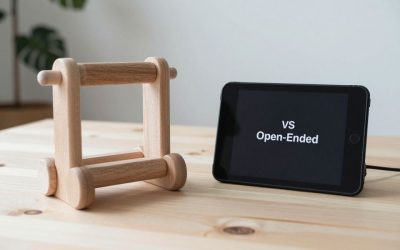
Open-Ended, No “Wrong Way” Play
Some toys deliberately skip the self-correcting design in favor of pure exploration — useful for toddlers who get frustrated by puzzles with only one right answer.
Tobbles Neo
Weighted, rounded pieces that spin, stack, nest, or topple depending on how a toddler chooses to play with them, with no single correct configuration to get “wrong.”
Fat Brain Toys Dimpl
Dimpl isn’t a traditional stacker but shares the same open-ended, no-wrong-answer appeal, using silicone bubbles that pop in and out repeatedly with a satisfying resistance — a good companion pick for toddlers who gravitate toward the Tobbles Neo’s forgiving, exploratory style of play.
Bath-Time Stacking
Stacking doesn’t have to stop at bath time, and water play adds pouring and dumping to the usual stacking motion.
KIDSTHRILL Rainbow Stacking Cups
Ten thick plastic cups that nest and stack into a 25-inch tower, with drain holes built in specifically for bath and water-table use, and thick enough construction to survive chewing and throwing.
How to Tell When a Toddler Has Outgrown a Stacking Toy
The signal usually isn’t boredom with stacking itself — it’s a toddler blowing through a 5-piece stacker in seconds and immediately looking for something else. That’s the point to move from simple ring stackers to multi-attribute sorting boards, and eventually to shape puzzles and basic building sets, rather than buying a second simple stacker that offers the same level of challenge.
Material choice is worth a closer look beyond the usual wood-versus-plastic debate, since the specific finish and construction can matter as much as the base material itself. Wooden stackers and sorting boards, like the Melissa & Doug or Wood City sets, tend to feel more substantial and often use water-based, non-toxic paints, but they can chip or splinter if dropped repeatedly on hard floors over years of use. Recycled-plastic options like Green Toys are typically dishwasher-safe and more water-resistant for bath-time crossover use, while still avoiding some of the chemical concerns associated with lower-quality plastic toys. Neither material is universally better — it mostly comes down to how the toy will actually be used day to day.
FAQ
Is a wobbly base actually better, or just a design quirk?
For early stackers, yes — a slightly unstable base means less precision is needed to successfully place a ring, which keeps the activity rewarding rather than frustrating for a 9-12 month old still developing fine motor control.
My toddler just wants to knock the stack over, not stack it. Is that still useful play?
Yes — cause-and-effect learning (stack it, knock it, watch it fall, repeat) is a legitimate developmental stage that typically comes before a toddler is interested in stacking for its own sake. It usually resolves on its own with age and continued exposure.
Do sorting toys need to be wood, or is plastic just as good developmentally?
Plastic sorting toys offer the same cognitive benefits — the material mostly affects durability, weight, and bath-time use (plastic handles water better) rather than the learning value itself.
How many pieces should a stacking toy have for a 2-year-old?
Ten or more pieces, or a multi-attribute sorting challenge, tends to hold a 2-year-old’s interest longer than a basic 3-5 piece stacker, which most toddlers master well before their second birthday.
Is recycled plastic, like Green Toys uses, actually safe for toddlers?
Yes — brands marketing recycled-plastic toys for this age range are still required to meet the same US toy safety standards as any other children’s product, including testing for lead and phthalates, so the recycled material itself isn’t a safety trade-off.
Should I buy a stacking toy and a fidget/sensory toy like Dimpl separately, or will one cover both needs?
They generally serve different purposes — stacking and sorting toys build spatial and categorization skills, while a sensory fidget toy like Dimpl is more about repetitive tactile feedback, so most toddlers benefit from having at least one of each rather than treating them as interchangeable.

Write Your Review
No reviews yet. Be the first to share your experience!