Sensory toys for toddlers are built around texture, sound, light, and resistance rather than a single “correct” outcome — the point is exploring how something feels or responds, not solving it. They’re genuinely useful for toddlers working through a picky or sensitive phase with textures, and for channeling the fidgeting energy that shows up constantly at this age. Here’s what’s actually worth buying.
Textured Press-and-Pull Toys
These toys reward repeated poking, pressing, and pulling — ideal for a toddler who wants immediate tactile feedback.
Infantino Sensory Press & Stay Blocks
Soft fabric blocks with varied textures and a press-and-stick design, letting toddlers build and knock down a tower without the noise or hardness of wooden or plastic blocks.
Battat Bristle Blocks
Interlocking blocks covered in soft, flexible bristles that stick together at any angle, giving a different hand-feel than smooth plastic blocks while still functioning as a building toy.
Melissa & Doug Sunny Patch Giddy Buggy Sensory Ball
A textured, squeezable ball with raised bumps and ridges meant for rolling, squeezing, and tossing, giving a toddler a different grip-and-press experience than flat press-and-stay blocks while still rewarding repeated handling.
Latch and Lock Boards
Latch boards tap into the toddler fascination with locks, hinges, and buttons found around the house — safely contained on one board instead of on actual cabinets and doors.
Melissa & Doug Latches Board
A wooden board with multiple real latches, hooks, and sliding locks, which satisfies the toddler urge to open and close things without them doing it to the actual pantry door.
Skip Hop Explore & More Sensory Development Activity Board
This board combines spinning gears, textured fabric panels, and a small mirror into one toddler-height activity station, aimed at the same latch-and-lock curiosity but with a broader mix of sensory inputs than a pure latches board.
All-in-One Fidget Toys
For toddlers who want constant novelty in a single object, a multi-feature fidget toy covers several sensory inputs at once.
Fisher-Price My First Fidget Cube
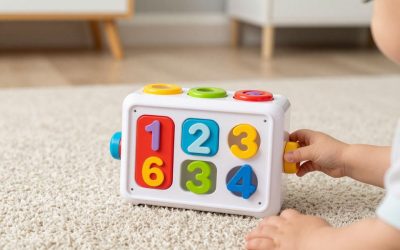
Loaded with different activities on all six sides — rubber and metal buttons, a joystick, spinning rollers, and a fingerprint-scanner-style button — aimed at toddlers who outgrow simpler single-action toys quickly.
Drawing and Doodling
Doodle boards add a visual-sensory element (watching marks appear and disappear) without the mess of actual markers.
Crayola Musical Doodle Board
A portable doodle board that adds music and light to the usual magnetic-drawing format, useful for car rides and restaurant waits where actual crayons aren’t practical.
Hands-On Tactile Play
For toddlers past the mouthing stage (generally 2+), moldable and squeezable play materials add a different kind of sensory input than any fixed toy can.
Play-Doh Shapes & Colors Dino Starter Set
An age-appropriate Play-Doh starter kit with dinosaur-shaped tools and molds, giving structure to the squeezing and shaping play that’s otherwise fairly open-ended.
Matching the Toy to the Sensory Need
Not every “sensory toy” fits every toddler. A toddler who seeks out noise and movement (constant fidgeting, loves loud environments) often does better with the fidget cube or doodle board; a toddler who seems overwhelmed by too much stimulation often does better starting with the latches board or bristle blocks, which are quieter and more predictable. Watching which toys your toddler returns to on their own is a better guide than buying based on an age range alone.
It’s also worth thinking about where and when a sensory toy actually gets used, since that affects which features matter most. A toy meant for car rides or restaurant waits — like the Crayola Musical Doodle Board — benefits from being quiet-adjustable and self-contained with no loose pieces that can roll under a seat, while a toy meant for home playroom use has more freedom to include loose parts, larger footprints, or louder sound features since there’s no risk of losing pieces or disturbing people nearby. Matching the toy’s portability and noise level to its actual use case, not just its sensory category, tends to get more real use out of the purchase.
FAQ
Are sensory toys only for toddlers with sensory processing differences?
No — all toddlers benefit from sensory play as part of normal development. Occupational therapists recommend sensory toys for kids with diagnosed sensory processing needs specifically, but the toys themselves are standard developmental toys for any toddler.
Is Play-Doh safe for toddlers who still put things in their mouths?
Supervised use is generally fine for toddlers past the mouthing stage, but Play-Doh isn’t a food item and shouldn’t be used unsupervised with a toddler who’s still reliably mouthing objects — check the product’s stated minimum age before buying.
My toddler only wants the fidget cube and ignores quieter toys. Should I worry?
Not necessarily — many toddlers gravitate toward the most stimulating option available. Rotating toys so the fidget cube isn’t always accessible, rather than removing it entirely, often brings a toddler back to quieter toys on their own.
Do these toys need to be cleaned differently than regular toys?
Fabric-based sensory toys (like the press-and-stay blocks) typically need spot cleaning or gentle hand-washing since they can’t go through a dishwasher or boiling sanitizer the way bottle parts can — check the specific care label before washing.
How many sensory toys does a toddler actually need at once?
Rotating a handful of toys (roughly 3-5 available at a time, with others stored away) tends to hold a toddler’s interest longer than having every toy accessible simultaneously, which can overwhelm or dilute attention across too many options.
Can a sensory activity board like Skip Hop’s replace several single-purpose sensory toys?
To some extent — a combined activity board covers multiple sensory inputs (texture, sound, mirrors, latches) in one object, which can be a practical space-saving choice, though a toddler with a strong preference for one specific input (like latches alone) may still prefer a dedicated single-purpose toy.
Write Your Review
No reviews yet. Be the first to share your experience!