Car seats aren’t a one-time purchase for most families — babies move through at least two, sometimes three, seat types between birth and the booster years. The confusing part isn’t safety (every seat sold in the US meets the same federal crash standards); it’s figuring out when your child has actually outgrown the one you have. Here’s a practical way to think through sizing at each stage, with real seats worth looking at along the way.
Stage 1: Rear-Facing Infant Seat (Birth to ~12 Months)
Infant seats are rear-facing-only and click into a base, which is why they’re the default choice for newborns — you can move a sleeping baby from car to stroller without waking them. The sizing cue to watch isn’t the weight limit printed on the box (often 30-35 lbs); it’s height. Once the top of your baby’s head gets within about an inch of the top of the seat shell, or their shoulders cross the top harness slots, it’s time to move up — most babies hit this well before the weight max.
Chicco KeyFit 35 Zip Infant Car Seat
A widely recommended infant seat known for a genuinely simple, hard-to-mess-up installation, which matters most in the newborn stage when you’re sleep-deprived and installing it for the first time.
Graco SnugFit 35 Elite Infant Car Seat
A newer Graco infant seat that extends the usable height range a bit longer than older Graco infant seats, which can delay the first seat transition.
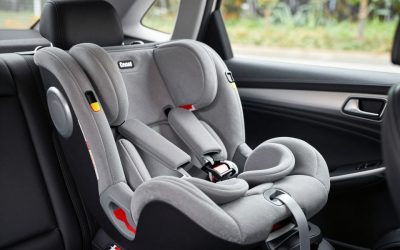
Stage 2: Convertible Car Seat (~12 Months Through Preschool)
Convertible seats install directly into the car (no detachable carrier) and switch from rear-facing to forward-facing as your child grows. Current guidance from the American Academy of Pediatrics recommends keeping kids rear-facing as long as the seat allows, not just until age 2 — many convertible seats now rear-face to 40-50 lbs specifically to support this. Sizing-wise, you’re again watching height and the harness slot position more than the weight number: if the top of the ears reaches the top of the seat shell in rear-facing mode, or shoulders are above the top harness slots in forward-facing mode, it’s time for the next stage.
Graco Extend2Fit 3-in-1 Convertible Car Seat
Built specifically to stretch out the rear-facing period with an extending leg-room panel, which is useful if you want to follow the “rear-facing as long as possible” guidance without your child’s legs feeling cramped.
Britax Poplar S Convertible Car Seat
Uses Britax’s ClickTight installation system, which is frequently cited as one of the easier convertible seats to install correctly on the first try — a real factor in how protective a seat actually is in practice.
Cosco Scenera Next Convertible Car Seat
A genuinely low-cost convertible seat that still covers rear-facing from 5 lbs and forward-facing up to 40 lbs, useful as a lightweight travel or grandparent’s-car second seat.
Stage 3: Booster Seat (Roughly Age 4+ and 40+ lbs)
Booster seats raise a child up so the vehicle’s own seatbelt fits correctly across the chest and lap rather than the neck and stomach. The real sizing test here isn’t age or weight alone — it’s whether the child can sit against the seat back with knees bent at the edge of the seat and feet flat on the floor, and whether the shoulder belt crosses the middle of the shoulder (not the neck). Many kids need a booster until 10-12 years old by this test, well past when parents assume they’ve “graduated.”
Graco TriRide 3-in-1 Car Seat
Converts through rear-facing, forward-facing harness, and highback booster modes, so it can be the only seat purchased from infancy through the booster years.
Chicco KidFit ClearTex Zip Highback Booster
A highback booster with a machine-washable cover and belt-positioning clips that help route the shoulder belt correctly across smaller frames.
A Few Sizing Mistakes Worth Avoiding
Don’t rush a transition just because a milestone birthday happened — move up only when the seat’s actual height/weight limits or harness slot positions say so. Don’t buy a convertible seat secondhand unless you’re certain of its full history (crash history and expiration dates matter). And don’t assume a bigger seat is automatically safer; an correctly-installed smaller seat that fits your child’s current size is safer than an oversized one with loose harness straps.
FAQ
Can I use a convertible seat from birth and skip the infant seat entirely?
Yes, most convertible seats accept babies from around 4-5 lbs, but you lose the detachable-carrier convenience that makes infant seats popular for the newborn stage.
Is it unsafe to keep using an infant seat past its height limit if the weight limit still allows it?
Yes — height matters as much as weight. A baby whose head is near the top of the shell needs more structure around the head than that seat is designed to provide.
How do I know my seat isn’t expired?
Check the manufacture date and expiration date printed on a sticker on the seat shell, usually 6-10 years from manufacture depending on the brand.
Do I need a different seat for every car I own?
Not necessarily — many convertible and infant seat bases are compact enough to move between two vehicles, though installing and uninstalling correctly each time takes practice. If you regularly switch cars (co-parenting, grandparents, carpools), a second base for an infant seat is often cheaper and easier than buying a whole second seat.







Write Your Review
No reviews yet. Be the first to share your experience!